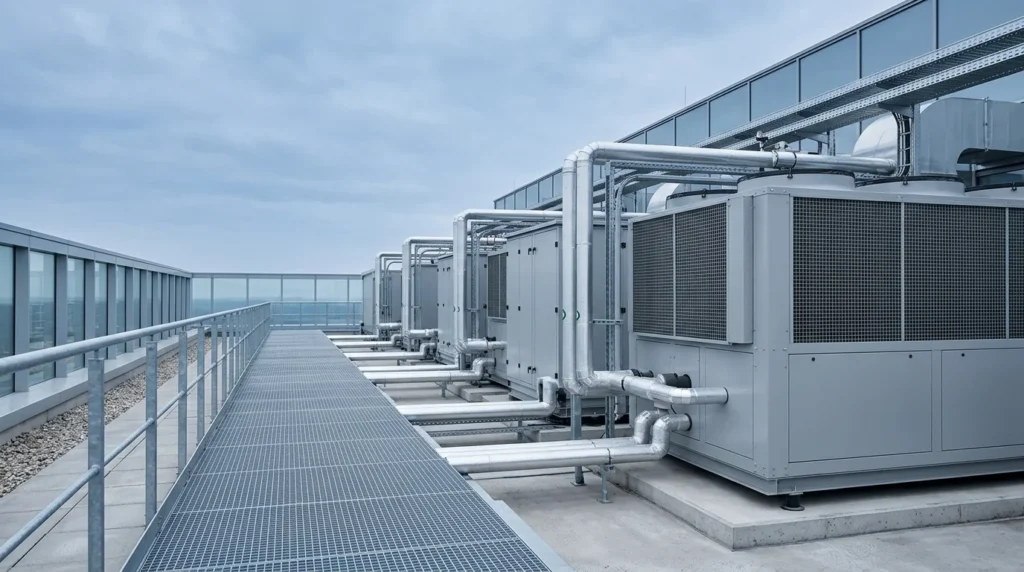
A chiller that stops on a Tuesday in July is not a „breakdown.” It’s a hotel day with complaints, an operating room that can’t be used, or a medicine warehouse out of temperature range. HVAC maintenance It exists to keep you from getting there. The problem is that many maintenance contracts are, in effect, "come when you call" contracts.
If you want a calendar of inspections for your building, with minutes of each visit, see the service page HVAC maintenance in Constanta.
What does maintenance mean and what does intervention mean?
They are two different things and deserve to be separated in the contract.
- Preventive maintenance It's scheduled. The technician comes twice a year, usually before the cooling season and before the heating season, and does the same operations each time, according to a list.
- intervention It's broken down. What matters is the response time written in the contract and whether the team has the usual parts with it.
A good contract has both, with clear deadlines. If yours only has interventions, you're always paying on an emergency basis and never knowing what's going to break.
What is checked during a maintenance visit?
The list varies by equipment, but for an office building, hotel, or clinic, a serious technician goes through:
- Filters for indoor units, air handling units and heat recovery units: cleaning or replacement, depending on the degree of clogging, not according to the calendar.
- Heat exchangers (evaporator, condenser): chemical or mechanical cleaning. A dirty condenser means higher consumption and a compressor working at its limit.
- Refrigerant circuit: pressures, superheating, subcooling, leak check. For equipment with fluorinated refrigerants, the European regulation on fluorinated gases requires periodic leak checks, with frequency increasing with agent load. Checks must be recorded in the equipment log.
- Electrical part: tightness of connections, currents on each compressor and fan, condition of contactors and start capacitors. This is where most future breakdowns are discovered.
- Condensate drainage: trays, condensate pumps, siphons. Clogged condensate means stained ceilings and, in clinics, a hygiene problem.
- automation: temperature sensors, thermostats, time programs, alarms. Many "malfunctions" are actually a wrongly set time program after a remodel.
- sanitizing indoor units and piping, where applicable. Details on page HVAC cleaning and sanitizing.
Each visit ends with a Report: what was done, what values were measured, what we recommend. Without it, you have nothing to defend yourself with during an inspection or in a discussion with the building owner.
How often
Practical rule for commercial buildings in Constanta, where the summer is long and the air is salty:
- Twice a year for air conditioning units, VRF/VRV and chillers: spring and autumn.
- Quarterly for filters of air treatment plants in clinics, laboratories and professional kitchens.
- Monthly for coarse filters in hotels with high occupancy in the season.
- Leakage checks within the deadlines required by the regulation, depending on the equipment.
In addition, high-power air conditioning systems are subject to periodic energy inspections required by the energy performance of buildings legislation. We will tell you on your first visit if yours is included and who can do it.
What does it cost you if you skip it?
We're not giving you made-up numbers. We're telling you what we saw on the ground:
- A compressor burned out due to a few lei starting capacitor that was not checked.
- Consumption much higher than normal, for months on end, due to clogged exchangers. The bill gradually increased and no one linked it to the air conditioning.
- A hotel that lost reservations in the middle of the season because the external unit stopped working on a weekend and no one had an intervention contract.
- A clinic with stained ceilings and smell, from clogged condensation, just before an inspection.
We calculate the maintenance cost for your case, based on the number and type of equipment. You then compare it with a single day of downtime and decide.
What an HVAC maintenance contract looks like that you can sign with confidence
- List of equipment, with model and location, in the appendix.
- List of operations for each visit.
- Visits calendar and failure response time, written.
- What is included and what is billed separately (refrigerant, parts, consumables).
- Minutes after each visit and register for tightness checks.
- Who keeps in touch with you: one number, one person.
If you already have a contract and you don't find at least four of the six points in it, it's worth a discussion.
How we work
We come to the site, take inventory of the equipment and tell you openly what is worth maintaining and what is at the end of its life. You will receive the offer within 3-5 business days, with the calendar of scheduled checks and the response deadline for air conditioning interventions. If you also have electrical or fire detection installations in the same building, we put them in the same contract, with the same team.
Send us the list of equipment or a picture of their nameplates and we tell you which inspection schedule makes sense for your building: request a quote.