Fire extinguishing systems in Constanta
The fire extinguishing installation that your ISU scenario requires, from the hydraulic calculation to the test report: hydrants, sprinklers, gas for the server room.
The extinguishing agent, the triggering method and the protection of people must be chosen according to the specific risk: water through hydrants or sprinklers for buildings and warehouses, gas for technical rooms and archives, foam or powder for areas with flammable liquids. A solution suitable for a technical space may be unsuitable in an occupied area or in a warehouse.
GreenSoft designs and implements fixed extinguishing systems, from indoor and outdoor hydrants and installations sprinklers to gas, foam or powder extinguishing, within the limits of the authorizations and the project, correlated with the fire safety scenario. The fuel, space geometry, occupancy, ventilation, operational continuity and the consequences of the agent on the equipment are analyzed.
The solution includes detection and triggering logic, alarming, interlocks and safety conditions. At reception, tests and operating responsibilities are documented, and maintenance tracks the actual availability of the system.
We also do design: hydraulic calculation, sizing of the water utility and pumps, diagrams and plans, drawn up by an authorized designer and correlated with the fire safety scenario, for the ISU's approval and authorization.
What does the service include?
- Design: technical design of the extinguishing installation (hydrants, sprinklers, gas) with an authorized designer, for ISU approval and authorization
- Risk analysis and choice of extinguishing principle
- Indoor hydrants: network, boxes, hoses, discharge pipes, water management and pumps
- Outdoor hydrants: ring network, above-ground or underground hydrants, water reserve
- Sprinklers: water-water, water-air and pre-action installations, control stations, pumps
- Gas extinguishing (FM200, Novec, Inergen), foam and powder for technical spaces and flammable liquids
- Networks, containers, fittings and unloading devices
- Detection, alarming and triggering commands
- Interlocks, signaling and safety conditions
- Tests, documentation and maintenance
Water extinguishing: indoor, outdoor hydrants and sprinklers
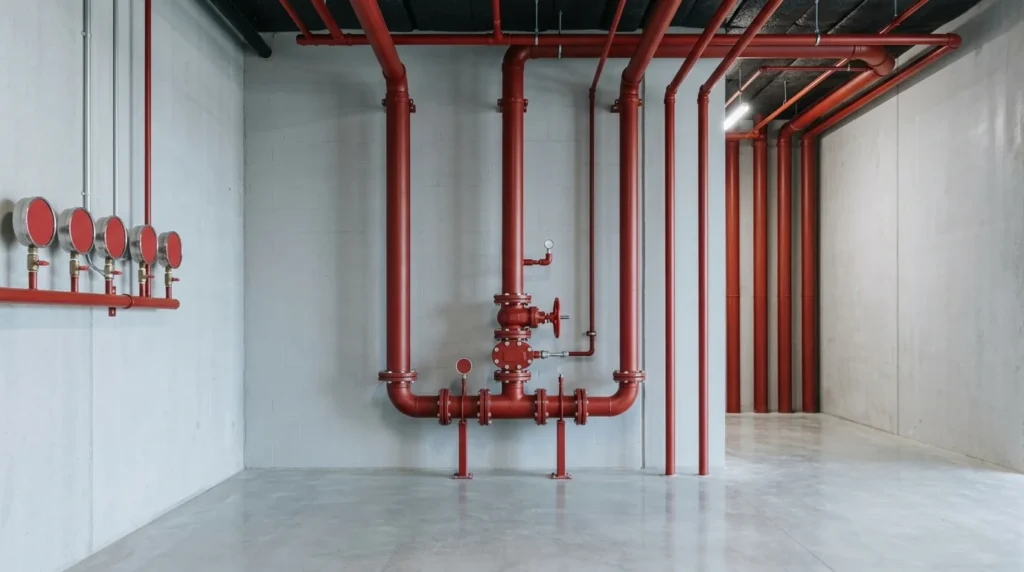
For most buildings, the regulation requires extinguishing with water. Indoor hydrants are the staff's first intervention: boxes with hose and discharge pipe on each level, supplied from a water utility with a reserve and pumps that start automatically when the pressure drops. Outdoor hydrants supplies firefighters: ring network around the building, above-ground or underground hydrants at the required distances, water reserve sized for the intervention time.
Sprinklers self-extinguishing: each head opens only at the temperature of the fire, sprays exactly the burning area and triggers the alarm via the control station. We design water-to-water installations for heated spaces, water-to-air for parking lots and unheated warehouses and pre-action where an accidental discharge would cause damage. All start from the same water management, sized only once for hydrants and sprinklers, with main, backup and pilot pumps.
We deliver the complete system: tank or basin, pumping station, networks, fittings, signaling to the fire control center and documentation for the ISU approval and authorization, then periodic checks with a report.
Why GreenSoft
GreenSoft can coordinate detection, electricity, smoke extraction and extinguishing in a single functional matrix. In technical and industrial spaces, a wrong command can stop production; that is why the logic is tested only once, as a whole.
How the project is progressing
- Clarification of project risk and requirements
- System and interface sizing
- Installing and checking components
- Testing logic and teaching instructions
For which types of sites
- Hotels, office buildings and shopping centers (hydrants, sprinklers)
- Industrial buildings, warehouses and parking lots (sprinklers, external hydrants)
- Technical rooms, data centers and archives (gas)
- Professional kitchens (extinguishing hoods)
- Gas stations and areas with flammable liquids (foam, powder)
- Public institutions and educational units
Tell us what building you have and what the fire safety scenario requires. You will receive the right extinguishing principle and quote within 3-5 business days.
Where we work
We cover the entire county of Constanta: Constanta municipality, Mamaia, Năvodari, Ovidiu, Agigea, Eforie, Techirghiol, Mangalia, Medgidia and Cernavodă, including the port perimeter, based on the work license in the Port of Constanta. For larger works, we travel throughout Dobrogea.
Useful resources
Frequently asked questions
When are indoor hydrants mandatory and when are sprinklers?
It depends on the purpose, area, number of floors and people of the building, according to the fire safety standard and fire safety scenario. As a guide, indoor hydrants appear from medium-sized office, hotel and commercial buildings upwards, and sprinklers appear in warehouses, large covered parking lots, shopping centers and high-rise buildings. We check what applies to your building before the project.
Can I use the same water supply and pumps for hydrants and sprinklers?
Yes, the water utility is sized for simultaneous operation as required by the regulations, with reserve and flow for both systems and with main, reserve and pilot pumps. This reduces cost and space compared to two separate installations.
Why is gas extinguishing recommended instead of water for server or archive rooms?
Gas extinguishes fires without getting wet and without residue, so it doesn't destroy servers, electronics or documents, exactly what you want protected in such a room. Water, on the other hand, would sometimes cause more damage than the fire itself. That's why gas is the standard for spaces with high technical or documentary value.
Are the gases used in automatic extinguishing systems dangerous to people if they are in the room?
Modern agents (FM200, Inergen) are designed to extinguish at concentrations safe for humans, and the system includes an audible warning and a delay before discharge, for the evacuation of personnel. By following the procedures, the risk is minimal. We configure the signaling and times according to the regulations.
What is a room tightness test (Door Fan Test) and why is it mandatory for gas systems?
The Door Fan Test measures the tightness of the room to confirm that the gas remains at the required concentration long enough to extinguish the fire. If the room leaks through cracks or gaps, the extinguishing will fail. The test is mandatory upon commissioning and periodically, and we perform it and fix any leaks.
How often should fire hydrant networks and pumps be checked?
Hydrants and pumps are checked periodically, usually quarterly or semi-annually for functional tests and annually for a complete check, according to regulations. The pressure, flow and automatic start of the pumps are tested. We include these checks in the maintenance contract, with the related documentation for the ISU.
How does a sprinkler system work and how does it prevent accidental triggering?
Each sprinkler has a thermosensitive element (fluid bulb) that only breaks at the temperature of the fire, so only the head above the fire is activated, not the entire installation. Accidental triggering without heat is practically excluded by design. This way you have localized, efficient and waste-free extinguishing.
Does the system require separate detection?
Many automated systems use detection and confirmation logic. The exact architecture results from the technical solution.
Shall we discuss your project?
Free initial technical consultation and quote within 3–5 business days.