
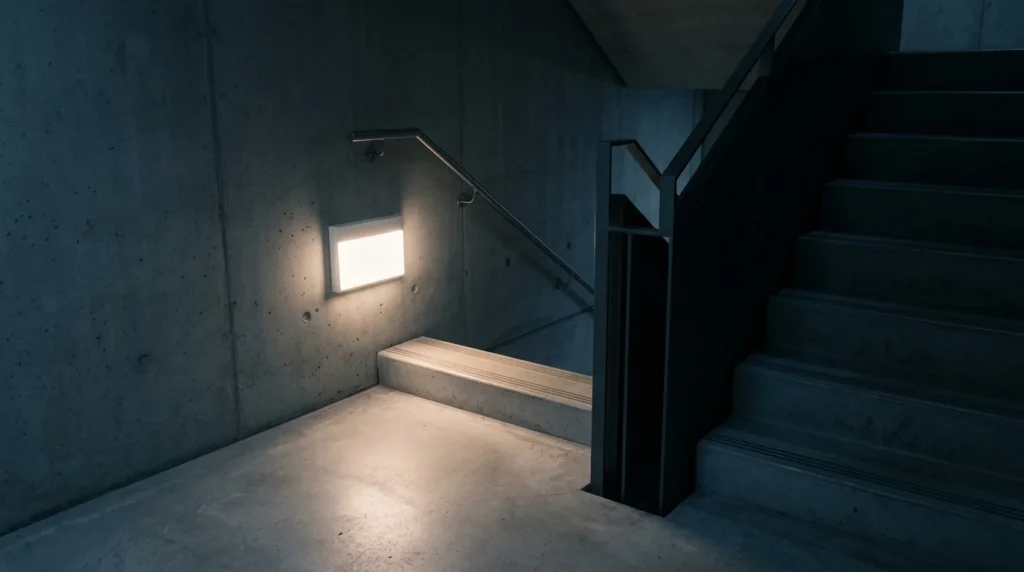
Everything you need to know about safety lighting in commercial, industrial and public buildings
In the event of a power outage, the first few seconds are critical. Without lighting, people can panic, escape routes become difficult to identify, and rescue teams are hampered.
For this reason, safety lighting is not just a technical requirement, but an essential element for protecting life and limiting risks in emergency situations.
In Romania, numerous categories of buildings must be equipped with emergency lighting systems designed and maintained according to applicable technical regulations.
In this article we explain where it is mandatory, what types of bodies exist, and how periodic checks should be performed.
What is safety lighting?
Emergency lighting is the installation that automatically comes into operation when the normal power supply is interrupted.
Its purpose is to allow:
- safe evacuation of people;
- identification of emergency exits;
- reducing the risk of accidents;
- continuation of essential activities;
- facilitating the intervention of firefighters and rescue teams.
It operates independently of normal lighting, using its own power sources (integrated batteries or central sources).
What does the legislation say?
The need for safety lighting results from all the regulations applicable to electrical constructions and installations, as well as from the requirements of fire safety.
Depending on the purpose and characteristics of the building, the design and execution must comply, as appropriate:
- I7 standard regarding electrical installations;
- fire safety regulations (P118 series, as applicable);
- European standards applicable to emergency lighting fixtures and systems;
- the specific requirements set out in the technical design and fire safety scenario.
The type, location and autonomy of the bodies are established by the project, depending on the construction category and risk analysis.
Where is emergency lighting mandatory?
In practice, emergency lighting is found in many types of buildings, including:
- office buildings;
- hotels and guesthouses;
- hospitals and clinics;
- schools and universities;
- shopping centers;
- industrial buildings;
- warehouses;
- performance halls;
- restaurants;
- above-ground and underground parking lots;
- public institutions.
The obligations differ depending on the purpose, area, height and capacity of the building.
The main types of safety lighting
Not all bodies have the same role. Depending on the use, the system may include several categories.
Emergency lighting
It is the most well-known type and is designed to guide occupants to emergency exits.
Mounts on:
- escape routes;
- corridors;
- ladder houses;
- hallways;
- final exits;
- changes of direction;
- intersections of escape routes.
This must allow rapid identification of the route even in conditions of smoke or reduced visibility.
Anti-panic lighting
It is designed to reduce the risk of panic in open spaces.
It is used in:
- large hallways;
- conference rooms;
- commercial spaces;
- reception areas;
- atriums;
- areas with crowds of people.
It provides a minimum level of lighting that allows for safe orientation and movement.
Lighting for high-risk areas
It is intended for spaces where sudden switching off of lighting can cause accidents.
Examples:
- technical rooms;
- electrical panels;
- thermal power plants;
- industrial spaces;
- laboratories;
- workshops.
This allows for the safe shutdown of equipment and the evacuation of personnel.
Exit signaling lighting
Emergency exit lights are an integral part of the evacuation system.
They must be visible from any relevant point and remain functional even in the absence of main power.
Autonomous units or central battery system?
There are two main solutions.
Autonomous bodies
Each light fixture has its own battery.
Advantages:
- simple installation;
- low initial cost;
- easy expansion;
- suitable for small and medium buildings.
Disadvantages:
- each battery must be checked and replaced periodically;
- Maintenance involves interventions on each body.
Central battery system
All bodies are powered by a centralized source.
Advantages:
- easier management in large buildings;
- centralized monitoring;
- simplified maintenance;
- autonomy controlled from a single point.
It is frequently used in:
- hospitals;
- airports;
- shopping malls;
- office buildings;
- large hotels.
How long should lighting operate after a power outage?
The required autonomy is established by the project and the regulations applicable to the type of building.
In practice, the most common autonomies are 1 hour, 2 hours or 3 hours, depending on the purpose of the construction and the requirements of the fire safety project.
Choosing insufficient autonomy can lead to non-conformities in operation.
Periodic checks are mandatory
Installing the system is not enough. In order for it to work when needed, periodic checks are necessary.
These may include:
- checking the functioning of each body;
- simulation of normal power outage;
- checking battery autonomy;
- control of indicator lights;
- checking chargers and power supplies;
- inspecting electrical connections;
- checking automatic monitoring systems.
The results of the checks must be recorded in the maintenance and operation documents.
The most common problems encountered
In maintenance activities we frequently encounter:
- degraded batteries;
- bodies that no longer start in emergency mode;
- defective evacuation indicators;
- bodies disguised by furniture or advertisements;
- changes to the compartmentation without adapting the escape routes;
- lack of periodic checks;
- bodies replaced with non-conforming models;
- lack of updated documentation.
These deficiencies may affect the evacuation of people and may generate non-conformities found during inspections by the authorities.
How can a modern system reduce costs?
Current technology offers solutions that simplify operation:
- low-consumption LED fixtures;
- automatic self-test;
- centralized monitoring;
- automatic defect reporting;
- extended lifespan;
- batteries with improved performance;
- integration with building management systems (BMS).
These functions reduce the time required for checks and allow for the rapid identification of potential problems.
How GreenSoft can help you
GreenSoft designs, installs and maintains safety lighting systems for commercial, industrial and institutional buildings.
Our services include:
- design of safety lighting installations;
- supply and installation of autonomous or central battery units;
- integration with fire detection and alarm systems;
- functional checks and periodic maintenance;
- replacement of batteries and defective equipment;
- technical documentation necessary for operation and specialized controls.
Conclusion
Emergency lighting is one of the most important installations for protecting people in the event of an emergency. Proper design, choosing the right equipment and performing regular checks contribute to the system functioning exactly when needed.
Investing in a modern, efficient and properly maintained system not only means complying with legal obligations, but also increasing the level of safety for employees, customers and visitors.
You need electrical installations and safety lighting in Constanta? Request a quote →