
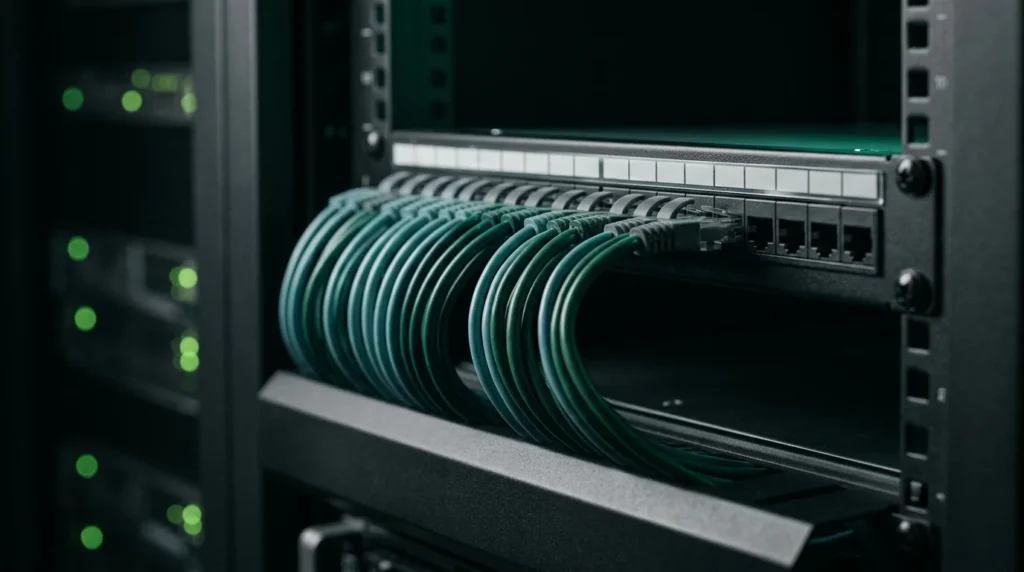
Complete guide to designing a future-ready network infrastructure
The guide below will help you choose. For design, execution and certification with a report on each outlet, in Constanta, see structured cabling Constanta.
Whether we are talking about an office building, a hotel, a factory, a hospital or a smart home, all modern systems have one element in common: communications network.
Computers, IP phones, video cameras, Wi-Fi access points, security systems access control, fire panels, IoT equipment and many other devices depend on a reliable cabling infrastructure.
Unfortunately, one of the most costly mistakes developers make is choosing an undersized network infrastructure. The savings made during construction can lead to much higher costs when the need for expansion, insufficient speeds, or cable replacement arises.
In 2026, Cat6 cabling is the reasonable minimum for most new projects, and in many situations it is even recommended to use Cat6A.
What is structured cabling?
Structured cabling represents the standardized communications infrastructure of a building.
It is designed to simultaneously serve:
- computer network;
- the internet;
- IP telephony;
- video surveillance cameras;
- access control;
- detection and alarm systems;
- IoT equipment;
- BMS (Building Management System) systems;
- Wi-Fi access points;
- printers and other network equipment.
A well-designed infrastructure allows for modifications and expansions without major interventions on the building.
Why is Cat5e no longer enough?
Cat5e has long been the standard for 1 Gbps Ethernet networks and can still work in many scenarios.
However, today's requirements are very different from those of 10–15 years ago. Today, the same infrastructure must simultaneously support:
- 4K and 8K video cameras;
- Wi-Fi 6, Wi-Fi 6E and Wi-Fi 7 access points;
- VoIP phones;
- fast file transfers;
- network backups;
- intelligent automation systems;
- PoE power supply for a large number of devices.
Under these conditions, Cat5e quickly becomes a limitation, especially in new projects.
Advantages of Cat6 Cabling
Compared to Cat5e, Cat6 offers:
- better performance at high frequencies;
- reduced crosstalk;
- increased stability;
- better support for higher transfer speeds;
- excellent compatibility with modern equipment;
- an infrastructure more prepared for future technologies.
Additionally, the cost difference between Cat5e and Cat6 is usually small compared to the total cost of a project.
When is Cat6A recommended?
For projects where a long service life is sought or where there are high performance requirements, Cat6A represents a justified investment.
This is especially recommended for:
- data centers;
- modern office buildings;
- hotels;
- hospitals;
- university campuses;
- industrial buildings;
- smart buildings;
- company headquarters with intense data traffic.
Cat6A offers support for speeds up to 10 Gbps over distances up to 100 meters and better immunity to electromagnetic interference.
PoE power changes the rules
More and more equipment is powered directly through the network cable, using Power over Ethernet (PoE) technology.
These include:
- IP cameras;
- VoIP phones;
- Wi-Fi access points;
- access controllers;
- RFID readers;
- IP intercoms;
- digital displays;
- sensors and IoT devices.
As the power delivered via PoE increases, the quality of the cable and connectivity becomes increasingly important to avoid losses and excessive heating.
It's not just the cable that matters
The performance of a network depends on the entire system.
O structured cabling professional includes:
- certified cables;
- compatible network sockets;
- quality patch panels;
- correctly sized racks;
- organized cable management;
- proper grounding;
- clear labeling of all connections;
- testing and certification of each route.
A single element of poor quality can affect the performance of the entire infrastructure.
Common mistakes in wiring projects
In practice, we often encounter the following problems:
- use of cables without certification;
- mixing components from different categories;
- lack of documentation and labeling;
- routes made without respecting the minimum radius of curvature;
- excessive proximity to power cables;
- lack of final testing;
- insufficient rack sizing;
- lack of reserves for expansions.
These compromises can generate difficult to identify and costly operational problems.
What standards must be met?
A structured cabling infrastructure must be designed and executed in accordance with applicable technical standards, such as:
- ISO/IEC 11801 series;
- European standards EN 50173;
- TIA-568 standards;
- manufacturers' requirements for the components used.
Compliance with these standards ensures interoperability, performance and the possibility of certification of the installation.
When is it worth investing in Cat6A or fiber optic?
For many modern buildings, a combination of copper and fiber optic offers the best solution.
Typically:
- Cat6 or Cat6A is used up to the user outlets;
- Optical fiber is used for connections between floors, buildings or technical rooms.
This architecture offers high performance, flexibility, and the ability to expand without replacing the entire infrastructure.
How much does it cost to choose Cat6 instead of Cat5e?
In most projects, the difference in material cost is relatively small compared to the total construction investment.
Instead, subsequent replacement of the wiring involves:
- breaking walls and ceilings;
- interruption of activity;
- restoration of finishes;
- labor and material costs;
- periods of system unavailability.
For this reason, choosing a modern infrastructure right from the construction phase is, most of the time, the most economical long-term decision.
How GreenSoft can help you
GreenSoft designs and executes complete structured cabling infrastructures for commercial, industrial and residential buildings.
Our services include:
- voice-data network design;
- Cat6, Cat6A and fiber optic structured cabling;
- installation of racks and patch panels;
- certification and testing of routes;
- integration with video surveillance, access control, fire detection and automation systems;
- maintenance and expansion of existing infrastructures.
We use certified components and comply with international cabling standards to deliver reliable, easy-to-manage networks that are ready for future requirements.
Conclusion
In 2026, structured cabling will no longer be just an infrastructure for computers, but the foundation of all digital systems in a building. Choosing a solution based on Cat6, and where justified on Cat6A and fiber optics, offers performance, flexibility and a much longer life of the investment.
The cost difference over older solutions is small, but the long-term benefits are significant. An infrastructure designed correctly today will be able to seamlessly support the technologies and applications your organization will use for years to come.
You need structured cabling and networks in Constanta? Request a quote →