
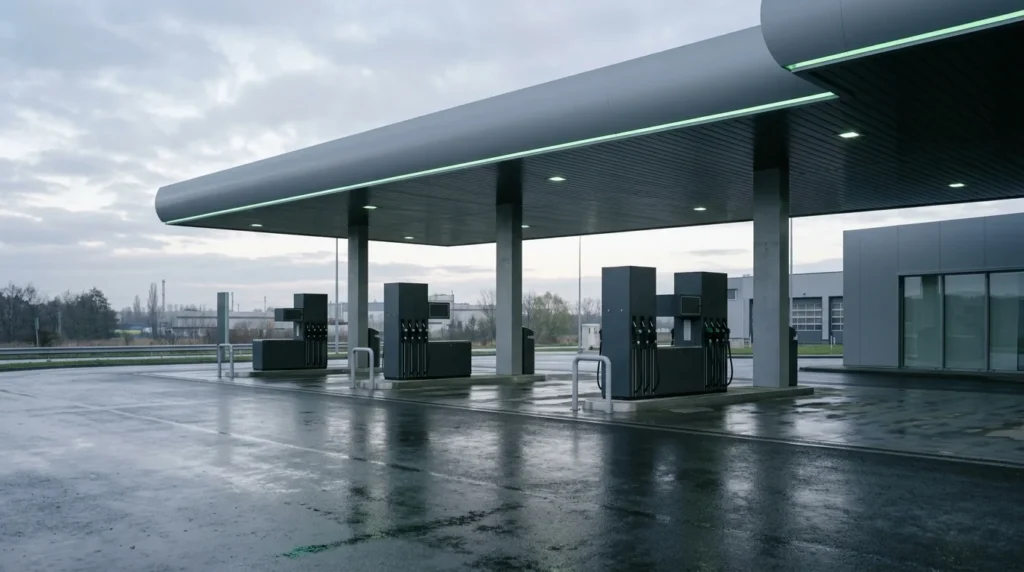
A system of gas detection for gas stations and LPG constantly monitors the atmosphere in risk areas and sounds the alarm before flammable vapors reach a dangerous concentration. Here's how it's designed, where the sensors are located, and what the installation must do when it detects a leak.
At a gas station, LPG station or LPG skid area, a seemingly minor leak can quickly create a dangerous atmosphere. Gasoline, propane and butane vapors can accumulate near equipment, in poorly ventilated spaces or low-lying areas, and a spark or hot surface can become an ignition source.
Smell is not a method of protection, and a visual inspection cannot replace continuous monitoring. A well-designed gas detection system identifies the increase in the concentration of flammable vapors early and can command the necessary measures before the situation develops into a fire or explosion.
Why is gas detection necessary in fuel and LPG stations?
The risk does not only occur at the tank. Accidental emissions can come from pipes, flanges, fittings, valves, pumps, compressors, flexible connections, distributors or from unloading and filling operations. In the case of an LPG skid, several components are concentrated in a small area, which makes rapid detection of any leak essential.
The purpose of the installation is not only to signal the presence of gas. The system must provide sufficient time for the evacuation of people, the safe shutdown of the process, the isolation of the supply and the intervention of trained personnel. Therefore, gas detection must be considered as part of the entire safety concept of the facility, together with ventilation, emergency shutdown, fire detection and alarm system and operating procedures.
Explosimeter, vapor detector or gas detector?
The terms are sometimes used as if they refer to the same equipment, but their roles are different.
The portable explosive gas meter is usually used for spot checks by personnel: before an intervention, upon entry into a technical space or to locate a possible accumulation. It can indicate the level of flammable gases as a percentage of the lower explosive limit, abbreviated LEL or LEL. It is an important tool for operation and maintenance, but does not replace a fixed installation that permanently monitors risk areas.
The fixed fuel vapor detector continuously monitors the atmosphere in the protected area. The sensor must be selected and calibrated for the substance or hydrocarbon family being monitored, as the response of a detector differs depending on the target gas and the technology used.
For LPG stations and skids, detectors suitable for propane, butane or the LPG mixture encountered in the installation are used. If the site also includes other risks, such as methane, carbon monoxide, hydrogen or oxygen deficiency, each situation must be analyzed separately. There is no universal sensor, automatically suitable for every gas and every location.
Where are the detectors located in a gas station?
The position of the sensor directly influences the reaction time. Gasoline, propane and butane vapors are, under normal conditions, heavier than air and tend to migrate to low areas. For this reason, chimneys, niches, gutters, channels, poorly ventilated areas and points where a leak could accumulate should be carefully analyzed.
In a fuel distribution station, surveillance may target the area of pumps and dispensers, tanker unloading points, filling ports, technical chambers, pump rooms, pipeline routes and other points established by the risk analysis. However, the location is not done according to a single rule of height or distance. The probable source of the leak, gas density, air currents, ventilation, geometry of the space, Ex zoning and manufacturer's instructions.
Specifics of detection at LPG stations and skids
In an LPG skid, detectors may be required near the pump or compressor, tank fittings, transfer connections, distributor, valves, and inside any enclosures or technical spaces where gas may accumulate. The exact configuration depends on the skid construction and its mode of operation.
Proper design considers the likely path of gas after a leak, not just the position of equipment. Obstacles, walls, platforms, wind direction, and natural or mechanical ventilation can influence where a hazardous concentration first forms.
In areas classified as potentially explosive, detectors, boxes, glands, cables and other components must be selected for the intended use and the characteristics of the area. The equipment marking, protection category, gas group and temperature class must be correlated with the ATEX documentation and the zoning of the facility.
What happens when a dangerous concentration is detected?
A modern detection installation is not limited to lighting up an indicator. Depending on the technical scenario established by the project, there may be two or more alarm thresholds, which allow for a gradual reaction.
When the configured thresholds are exceeded, the system can activate optical and acoustic warnings, transmit the alarm to the responsible personnel or dispatcher, start or intensify ventilation, stop pumps or compressors, control safety solenoid valves and initiate emergency shutdown of the process. Integration with the fire detection and alarm system, BMS or other monitoring systems must be carried out in a controlled manner, so that each command produces a safe and verifiable state.
Thresholds, timings and automations should not be copied from another site. They should be established based on the gas being monitored, the equipment used, the risk assessment, the manufacturers' instructions and the applicable security scenario.
Gas detection and fire detection are complementary systems
The gas detector monitors the appearance of a flammable atmosphere before ignition. The fire detection and alarm system identifies the effects of a fire through smoke, temperature, flame detectors or by manually triggering the alarm, depending on the protected space.
A gas station may contain commercial buildings, offices, warehouses, technical rooms and canopies, each with different risks. Effective protection results from the coordinated design of gas detection, fire detection and safety automation, not from the isolated installation of a few sensors.
Maintenance and calibration make the difference between an installed sensor and a functional system
Sensor performance can be affected over time by aging, contamination, dust, humidity, temperature, exposure to certain substances or lack of calibration. A detector that appears active on the panel may respond incorrectly if not checked with the appropriate test gas.
Maintenance should include inspection of equipment and connections, functional testing of detectors, calibration according to manufacturer's instructions, checking local and remote alarms, testing of controls to ventilation, pumps and solenoid valves, and recording the results. The frequency is determined by the manufacturer, environmental conditions, risk assessment and operational requirements of the facility.
GreenSoft services for gas stations and LPG installations
GreenSoft offers complete flammable gas and vapor detection solutions for fuel stations, LPG stations, LPG skids and associated technical spaces. The approach starts from the real risks of the site and aims at both early detection and controlled reaction of the installation.
Services may include analysis of the site requirements, selection of detection technology, solution design, installation of equipment and cables, configuration of the control panel, programming of thresholds and automations, integration with existing systems, testing, commissioning and periodic maintenance. We can analyze both new projects and existing installations that need to be modernized, expanded or brought to a better level of protection.
A correct solution does not start with choosing a detector from the catalog, but with understanding the technological process, possible sources of loss, and how the site should react to the alarm.
Related resources
- Fire detection and alarm — design, execution and commissioning
- Fire extinguishing — gas, water spray and foam installations
- smoke exhaust — exhaust of smoke and hot gases
- Electrical installations — Ex power supply, automation and zoning
- 7 mistakes that frequently lead to non-compliance
- Checklist for building managers
Request a technical assessment
Do you manage a gas station, LPG station or LPG skid and want to install or upgrade your detection system? The GreenSoft team can evaluate your existing configuration and propose a solution adapted to the risks, zoning and automation required.
Contact GreenSoft for the design, installation and maintenance of gas detection systems, fuel vapors and fire alarm installations.