Structured cabling in Constanta — design, execution and certification with report
Your network is only as good as the cabling underneath it.
A network that "works somehow" costs you when you least expect it.
Cables run without a plan, without labels, without testing. When the internet or a port goes down, no one knows what goes where — and a one-hour outage becomes a lost day for the entire office.
GreenSoft design and execute structured cabling in Constanta and throughout Dobrogea, since 2004. Cat6, Cat6A or fiber, organized racks and every outlet certified with professional tester, with report on each cable — the infrastructure on which the internet, IP telephony, and security systems have been based for years.
Fixed price offer within 48 hours — no obligations
For whom
- Offices and office buildings — scalable network, ready for expansion
- Hotels and guesthouses — data, voice and TV on the same orderly infrastructure
- Industrial and logistics halls — protected routes, fiber between buildings
- SEAP institutions and projects — complete documentation for reception and audit
What do you get?
- Copper and fiber cabling, rack + patch panel — everything in a unified system, not patchwork
- Rigorous labeling of each socket and each port — find any route in seconds
- Certification with report on each cable — proof that the network is keeping the parameters, not just "running"„
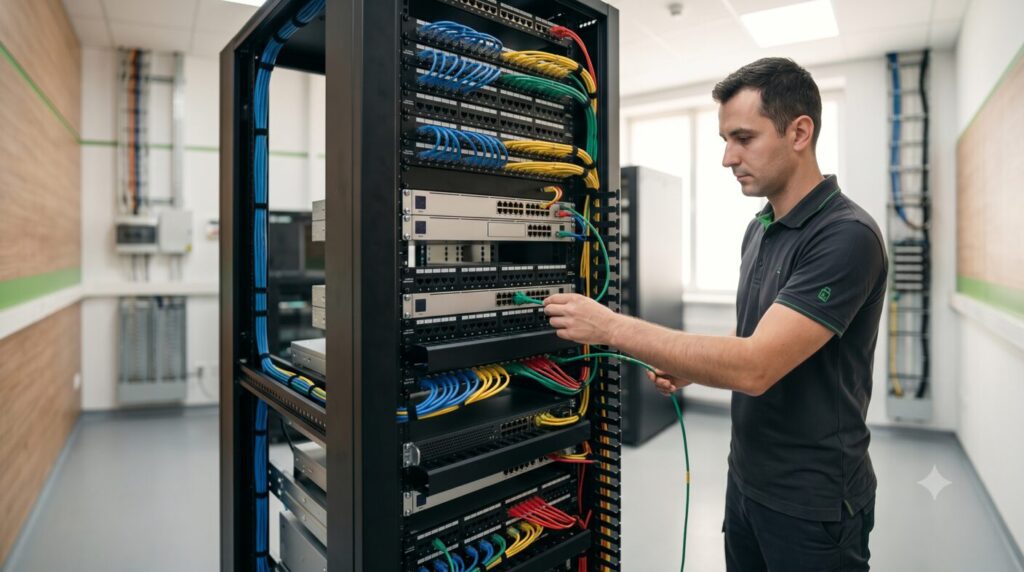
- Organized and documented rack — the scheme stays with you, not in the head of one person
- Integration with IP telephony and security — one infrastructure, fewer costs
How we work
- Free technical visit at the goal
- Project + fixed price offer in 48 hours
- Clean execution, with protected routes and full labeling
- Certification with report + handing over complete documentation
Fixed price offer within 48 hours — no obligations
Recent projects
Office building, Constanta — 120 positions. Cat6A on two floors, organized central rack, each outlet certified, with report submitted upon receipt of the work.
Hotel, seaside — 80 rooms. Data, voice and TV on single structured cabling, with fiber between the buildings. Hidden routes, zero visual impact in guest areas.
Production hall, Constanta county. Fiber optic between offices and warehouse, industrial copper on protected routes. Stable network in dusty and vibration environments.
How the project is progressing
- Inventory of connected points and equipment
- Establishing topology, routes and technical spaces
- Assembly, finishing and labeling
- Testing links and handing over documentation
For what types of goals
- Company headquarters
- hotels
- retail
- logistics spaces
- chow
- schools
- clinics and buildings that modernize the network
Useful resources
Frequently asked questions
How much does structured cabling cost?
It depends on the number of stations, the cable class (Cat6/Cat6A/fiber) and the building. There is no correct catalog price — there is a price for your project. Send us your plan or request a free technical visit and you will receive the exact offer within 48 hours, without any obligation.
Are you also doing internet/networking for a new office in Constanta?
Yes. We design the network from scratch: routes, rack, cabling, certification and commissioning — plus integration with IP telephony and video surveillance, if you have them. One supplier, one documentation.
What is structured cabling and why is it superior to networks pulled without a clear project?
It is a network designed as a unit: standardized routes, cables of the same class, organized rack, labeling and testing. Unlike cables pulled "wherever possible", a structured network is troubleshootable in minutes, easily expandable and supports data, voice and security in parallel. The result is a reliable and documented infrastructure.
What cable class (Cat6, Cat6A, Cat7) is recommended for a modern office building?
For modern offices, we typically recommend Cat6A, which supports 10 Gbps and will cover your needs for many years to come. Cat6 remains a good choice for tighter budgets and short distances. We choose the class based on your application, distance, and budget — and we explain the tradeoffs to you before you sign.
What is network certification and why do I need the technical report?
Certification means that each cable is tested with a professional tester and passes the standard parameters (attenuation, crosstalk, length, etc.). You receive a report on each outlet. This is proof that the network is working within parameters, useful for warranty purposes and mandatory for work acceptance and audit.
How does proper rack organization influence the stability of network equipment?
A tidy rack means proper ventilation, labeled cables, and easy access to equipment. This reduces overheating, intervention errors, and troubleshooting time. A chaotic rack, on the other hand, hides problems and prolongs any breakdown. We deliver organized and schematically documented racks.
Can a structured cabling network also support security systems or IP telephony?
Yes. A properly structured network supports data, IP telephony, IP video surveillance and access control in parallel, on the same infrastructure. This reduces costs and simplifies maintenance. We size the network from the beginning to cover all these services.
Fixed price offer within 48 hours
Free technical visit in Constanta and Dobrogea. Fixed price offer, no obligations.