
Safety and evacuation lighting for buildings
In the event of a fire or power outage, emergency lighting guides people to the exit and prevents panic.
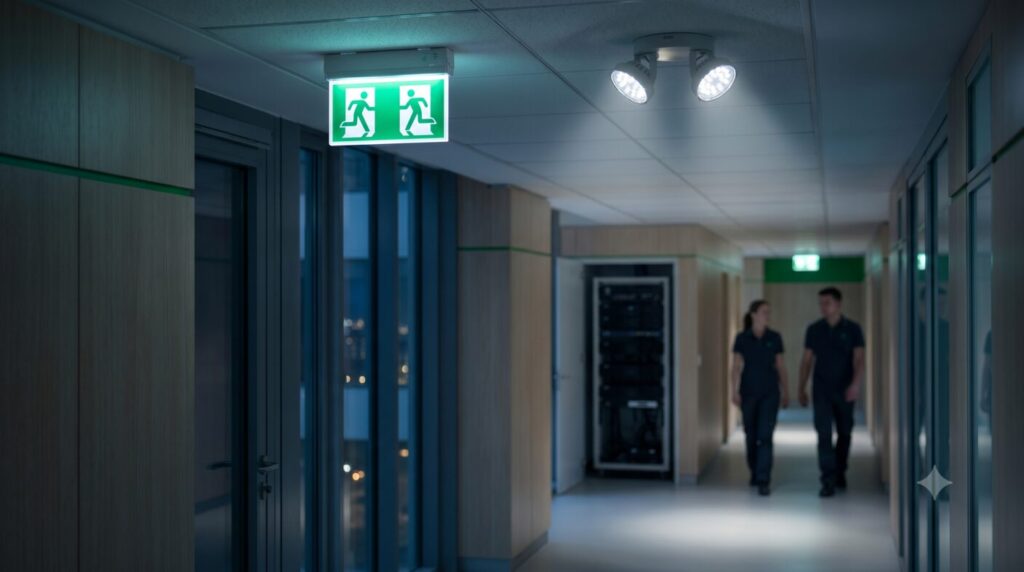
Power outage should not turn evacuation into an area of uncertainty. Emergency lighting should be designed, positioned and verified as part of the actual building use scenario.
GreenSoft creates solutions for marking escape routes, continuing essential activities and lighting at-risk areas, depending on the building's purpose and applicable technical documentation. Routes, autonomy times, power supply mode and integration with the rest of the electrical installation are analyzed.
The service may include installation, testing, equipment records and verification program. For objectives that enter into an approval or authorization process, GreenSoft prepares the technical part under its responsibility; the final decision belongs to the competent authority.
What does the service include?
- Analysis of escape routes and functional areas
- Sizing and placement of bodies
- Circuits, sources and associated controls
- Consistent markings and icons
- Functional tests, records and maintenance
Why GreenSoft
The solution is coordinated with the electrical installation, fire detection, smoke extraction and voice evacuation. This approach reduces contradictions between projects and simplifies testing of the entire scenario.
How the project is progressing
- Reviewing plans and objective requirements
- Designing or correcting the solution
- Equipment installation and labeling
- Autonomy testing and documentation delivery
For what types of goals
- Hotels and guesthouses
- commercial spaces
- OFFICE
- chow
- medical facilities
- educational institutions and public buildings
Request a safety lighting assessment to verify routes, autonomy and documentation before a reception, inspection or operating season.
Useful resources
Frequently asked questions
What types of safety lighting are mandatory for a public or commercial building?
The main types are: evacuation lighting, anti-panic lighting, hydrant lighting and lighting for risk areas. What is mandatory depends on the purpose and size of the building — we determine the exact configuration through the project, according to the I7 standard.
How long should emergency lighting batteries last in the event of a power outage?
The usual minimum autonomy is 1 hour of operation after power failure, sufficient for safe evacuation. For certain destinations, longer autonomy is required. We use bodies with quality batteries and periodically check the actual capacity of the batteries.
How is the maintenance and periodic checking of emergency lighting units carried out?
The verification involves periodic functional tests and autonomy tests at longer intervals. Self-testing bodies signal defects themselves. GreenSoft offers maintenance contracts with scheduled checks and a record book for control.
Do ISU inspectors check the presence and operation of safety lighting at checkpoints?
Yes, it is one of the standard points in ISU inspections. It checks for existence, correct location, operation during power failure simulation, and maintenance documentation. A properly designed and maintained system ensures your compliance during inspection.
Can I integrate emergency lighting into my central building management system (BMS)?
Yes. Modern addressable systems allow centralized monitoring of each body (status, battery, faults) and automatic reporting, which can be integrated into the BMS. This way, the administrator sees in real time which body requires intervention, without manual body-by-body checks.
Is emergency lighting the same as normal lighting?
No. It has roles, power modes, and operating criteria specific to emergency situations.
Can GreenSoft verify an existing system?
Yes. You can inventory the bodies, test their functioning and autonomy, and formulate a remediation plan.
Shall we discuss your project?
Free initial technical consultation and quote within 3–5 business days.